Lots of non-mainframe personal computer news to report. A couple days ago I managed to drop my ThinkPad about two feet onto a carpeted floor. The machine is over four years old now, and that drop was one too many for the hard disk.
I pulled the hard drive this morning so that I'm not tempted to work on it any more. I need a specialist to see what data he can pull off. Right now I'm using a bootable Linux CD to get online, yet another reason to like Linux. If there's nothing to save then I'll lose about 11 months of ancillary data. Most of what's important is protected in Lotus Notes replicated databases, though. Notable losses might include recent photos, many iTunes downloads (but they were all the free ones), and a couple spreadsheets I'll miss somewhat.
A more recent backup would have been nice, but I'll live.
I decided to purchase an Apple MacBook, and hopefully the new machine will arrive in about a week. Perhaps it's silly buying one's own machine mostly for office use, but I figure I'll splurge and meet new people who will want to know why there's a Macintosh in the office. Like the newer ThinkPads, the MacBook has a motion sensor which will park the hard disk heads before they crash. Unlike the newer ThinkPads the MacBook has a magnetic power cord attachment, so it is not possible to trip over the cord and send the machine tumbling.
If anyone has MacBook advice, feel free to share. I ordered the basic 1.8 GHz model with a 100 GB hard disk, VGA adapter (for presentations), and a free (after rebate) printer/scanner/copier. Is NeoOffice any good?
UPDATE: Apple shipped the printer but not the computer yet. So I called asking them to upgrade to two-day shipping to Chicago. "I'm sorry, we can't do that." The computer hasn't left, and it may not leave for days, but Apple can't seem to slap a two-day sticker on the box. All of which means I'll need a minor miracle to receive the computer before my flight back to Japan. There's still a chance, but I'm nervous.
LATER UPDATE: Like this consumer, I see that Apple is shipping my MacBook directly from China to Chicago. The good news is that Fedex thinks the MacBook will arrive on August 9, the day I arrive in Chicago. I hope Fedex is correct. Too bad Apple cannot parachute the MacBook into Tokyo before I leave.
Saturday, August 05, 2006


Thursday, July 27, 2006

Sunday, July 23, 2006
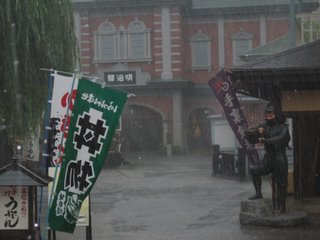
This Ninja Never Sleeps
It was raining on July 16, 2006, at Kyoto Studio Park, but there's at least one ninja who never sleeps.

I Stay
Management on both sides of the Pacific worked out their differences and, with my agreement of course, I will be staying in Japan, most probably until June 30, 2007.
UPDATE: Will I stay in Japan or will I live somewhere else in Asia? A little uncertainty surfaced yesterday. Stay tuned, blog readers.
UPDATE: Will I stay in Japan or will I live somewhere else in Asia? A little uncertainty surfaced yesterday. Stay tuned, blog readers.
Saturday, July 22, 2006
Bali Hi
I've had a somewhat strange travel week. A customer wanted to meet in Bali for several days, so on Tuesday I boarded the one Japan Airlines nonstop flight. When I arrived I learned that the customer decided to postpone the meeting, so I spent some of Wednesday on the beach. At about noon one of my colleagues asked, "Could you come to Kuala Lumpur then visit Singapore?" So I did.
Unfortunately Bali is not crowded right now. There's a persistent U.S. State Department travel warning, so lots of Americans avoid the place. (There were several vacationing Germans, however.) My flight appeared to be mostly full when I booked it, but the recent news about another Indonesian tsunami that killed hundreds in Java, not Bali, nonetheless largely emptied the 747 I boarded Tuesday. The hotel was likewise sparsely populated, and right now is supposedly high season.
I think lots of people consider the State Department warnings to have veto authority over their travel plans, but I have a somewhat different outlook. I do read them and take them seriously, and I do not like to take unnecessary risks. However, we all take risks. Crossing the street is risky, for example. As another example, last year I received a call asking if I would be willing to travel to Manila to teach an IBM internal class. One of my colleagues declined because there is a State Department travel warning for the Philippines. I did a little bit of research and determined the number of people in greater Manila who suffered violent death (murders, terrorist or otherwise) over the past few years. I compared that number to the same number for Dade County (Miami), my colleague's home area. I gave greater weight to more recent violence, and I also looked for differences in targeting Americans specifically. (There did not seem to be any particular targeting by nationality in either city.) Then I told him it would probably be a good idea to pack all his belongings and bring his whole family immediately and permanently to Manila because the rate of total death-inducing violent crime was about three times higher in Miami.
He went to Manila to teach the class.
As a side comment, I understand that the 9/11 deaths do not appear in official U.S. crime statistics or airline fatality statistics. Why? They should. Dead is dead.
There's a lesson here for computing. Sometimes staying put — inertia — is the riskiest move of all. That's especially true when your business changes and your information technology doesn't. For instance, in 1981 American Airlines introduced the AAdvantage frequent flyer program. Had Delta, Northwest, and other airlines not responded quickly with their own programs (and significant associated IT changes) they would have suffered grievous financial difficulties. "Our systems are stable, so we don't want to take the risk of changing them in any way" would have led to liquidation in that highly competitive industry. I try to explain this idea to my Japanese colleagues with partial success — many Japanese companies do not yet fully feel the effects of competition in what is still a highly cartelized domestic market. That's not to say that IT organizations should change systems and infrastructure just because there's a new whiz bang technology — that happened a lot in the 1990s — but IT should be highly responsive (or better yet anticipatory) to business needs. Perhaps this argument is obvious, but it is amazing how many IT organizations fail to serve business goals. In many such cases the CEO becomes incredibly frustrated, so he/she outsources the whole IT operation to, among others, IBM.
Unfortunately Bali is not crowded right now. There's a persistent U.S. State Department travel warning, so lots of Americans avoid the place. (There were several vacationing Germans, however.) My flight appeared to be mostly full when I booked it, but the recent news about another Indonesian tsunami that killed hundreds in Java, not Bali, nonetheless largely emptied the 747 I boarded Tuesday. The hotel was likewise sparsely populated, and right now is supposedly high season.
I think lots of people consider the State Department warnings to have veto authority over their travel plans, but I have a somewhat different outlook. I do read them and take them seriously, and I do not like to take unnecessary risks. However, we all take risks. Crossing the street is risky, for example. As another example, last year I received a call asking if I would be willing to travel to Manila to teach an IBM internal class. One of my colleagues declined because there is a State Department travel warning for the Philippines. I did a little bit of research and determined the number of people in greater Manila who suffered violent death (murders, terrorist or otherwise) over the past few years. I compared that number to the same number for Dade County (Miami), my colleague's home area. I gave greater weight to more recent violence, and I also looked for differences in targeting Americans specifically. (There did not seem to be any particular targeting by nationality in either city.) Then I told him it would probably be a good idea to pack all his belongings and bring his whole family immediately and permanently to Manila because the rate of total death-inducing violent crime was about three times higher in Miami.
He went to Manila to teach the class.
As a side comment, I understand that the 9/11 deaths do not appear in official U.S. crime statistics or airline fatality statistics. Why? They should. Dead is dead.
There's a lesson here for computing. Sometimes staying put — inertia — is the riskiest move of all. That's especially true when your business changes and your information technology doesn't. For instance, in 1981 American Airlines introduced the AAdvantage frequent flyer program. Had Delta, Northwest, and other airlines not responded quickly with their own programs (and significant associated IT changes) they would have suffered grievous financial difficulties. "Our systems are stable, so we don't want to take the risk of changing them in any way" would have led to liquidation in that highly competitive industry. I try to explain this idea to my Japanese colleagues with partial success — many Japanese companies do not yet fully feel the effects of competition in what is still a highly cartelized domestic market. That's not to say that IT organizations should change systems and infrastructure just because there's a new whiz bang technology — that happened a lot in the 1990s — but IT should be highly responsive (or better yet anticipatory) to business needs. Perhaps this argument is obvious, but it is amazing how many IT organizations fail to serve business goals. In many such cases the CEO becomes incredibly frustrated, so he/she outsources the whole IT operation to, among others, IBM.
Saturday, July 01, 2006
Still Looking for These Items
Tokyo's shops stock almost every product, but there are a few items I have found difficult to locate. Here are some examples:
1. Decaffeinated coffee. I like the taste of coffee, and coffee does have newly appreciated health benefits, but the caffeine increasingly bothers me. So I brought a one pound bag of chemical-free Swiss Water Process decaf from Chicago. There are two places I've found that serve a cup of decaf, probably the chemical kind. At the IBM coffee counter you can ask for "mild koh-hee" and you'll get decaf. It's 110 yen for a small cup, so it's a (subsidized?) bargain. Starbucks also serves decaf, although you have to wait several minutes because it's brewed in a decanter, on the spot, since it's an unusual request. There it's about 270 yen for what in the U.S. would be called "short" (a "secret" size in the U.S. that Starbucks sells but doesn't list), the same price as regular coffee. Presumably one could order decaf vanilla latte espresso hazelnut Sumatra mocha (or whatever) and, after considerable confusion, you might get it. I've never tried, primarily because I cannot fathom wrecking the taste of coffee with 16 other ingredients.
2. Unsalted peanuts. Haven't found them. Often the peanuts have MSG. Similar problem locating natural peanut butter.
3. Dried natto. A Japanese product that's hard to find in Japan! Refrigerated dried natto, yes, and it's pricey. Japan Airlines serves dried natto (snack) in business class, and they sell mail order dried natto for about 6000 yen (!) per box. I haven't found JAL-style dried natto in any of the shops yet. I really like dried natto snack, and supposedly it's an amazing health food. It has a wonderful yeasty flavor. There's a U.S. company that started to import dried natto snack, but unfortunately they have suspended orders at present while reorganizing.
4. English-style cider. I found "apple beer" in a restaurant once, but it was simply beer with some apple flavoring. Not even the giant Carrefour in Makuhari stocked hard cider. There's a bar ("pub") close to my apartment that lists a bottle of cider for 900 yen, but they were out during my one disappointing visit.
5. Dark beer. Guiness Stout (which I don't like) is reasonably popular, but a good, dark beer is a little hard to find. One of the Japanese beer companies makes a dark beer — I think it's called "Asahai Dark" — and it's quite good but oddly hard to find. (Asahai is a giant Japanese beer company.) One Japanese restaurant I visited served a 1400 yen boutique Japanese dark beer in a fancy brown bottle, and that was also good but obviously expensive. Carrefour stocked Newcastle, and I think Don Quijote does as well, at about 300 yen per bottle. The average Japanese sushi, yakitori, or other establishment only stocks pale beers.
6. Whole grain bread. Paul, the French-style bakery, has it priced at 400 yen for a small loaf. However, the last two trips they've been out of stock.
Of course there are many Asian products that are difficult to find in the U.S., and I like a lot of those products.
1. Decaffeinated coffee. I like the taste of coffee, and coffee does have newly appreciated health benefits, but the caffeine increasingly bothers me. So I brought a one pound bag of chemical-free Swiss Water Process decaf from Chicago. There are two places I've found that serve a cup of decaf, probably the chemical kind. At the IBM coffee counter you can ask for "mild koh-hee" and you'll get decaf. It's 110 yen for a small cup, so it's a (subsidized?) bargain. Starbucks also serves decaf, although you have to wait several minutes because it's brewed in a decanter, on the spot, since it's an unusual request. There it's about 270 yen for what in the U.S. would be called "short" (a "secret" size in the U.S. that Starbucks sells but doesn't list), the same price as regular coffee. Presumably one could order decaf vanilla latte espresso hazelnut Sumatra mocha (or whatever) and, after considerable confusion, you might get it. I've never tried, primarily because I cannot fathom wrecking the taste of coffee with 16 other ingredients.
2. Unsalted peanuts. Haven't found them. Often the peanuts have MSG. Similar problem locating natural peanut butter.
3. Dried natto. A Japanese product that's hard to find in Japan! Refrigerated dried natto, yes, and it's pricey. Japan Airlines serves dried natto (snack) in business class, and they sell mail order dried natto for about 6000 yen (!) per box. I haven't found JAL-style dried natto in any of the shops yet. I really like dried natto snack, and supposedly it's an amazing health food. It has a wonderful yeasty flavor. There's a U.S. company that started to import dried natto snack, but unfortunately they have suspended orders at present while reorganizing.
4. English-style cider. I found "apple beer" in a restaurant once, but it was simply beer with some apple flavoring. Not even the giant Carrefour in Makuhari stocked hard cider. There's a bar ("pub") close to my apartment that lists a bottle of cider for 900 yen, but they were out during my one disappointing visit.
5. Dark beer. Guiness Stout (which I don't like) is reasonably popular, but a good, dark beer is a little hard to find. One of the Japanese beer companies makes a dark beer — I think it's called "Asahai Dark" — and it's quite good but oddly hard to find. (Asahai is a giant Japanese beer company.) One Japanese restaurant I visited served a 1400 yen boutique Japanese dark beer in a fancy brown bottle, and that was also good but obviously expensive. Carrefour stocked Newcastle, and I think Don Quijote does as well, at about 300 yen per bottle. The average Japanese sushi, yakitori, or other establishment only stocks pale beers.
6. Whole grain bread. Paul, the French-style bakery, has it priced at 400 yen for a small loaf. However, the last two trips they've been out of stock.
Of course there are many Asian products that are difficult to find in the U.S., and I like a lot of those products.
Wednesday, June 28, 2006
U.S. Constitution 1, Insanity 0
The Flag Burning Amendment failed in the U.S. Senate. The Senate could muster only 66 votes as predicted, not the 67 required.
There are some new senators we can elect this November, including James Webb, Jon Tester, and Claire McCaskell, among others. Webb has already said he'd vote against this ridiculous amendment if it ever came up again, in agreement with Colin Powell. Not sure about the others yet. I'd really like to see this dumb idea sink well below 50 votes and then disappear for good, and evicting their "yea" vote opponents in Virginia, Montana, and Missouri, respectively, would be a great start.
Along the same lines, could the good people of Connecticut please, please get rid of Joe Lieberman? I voted against Lieberman the one chance I had, in 1988 when I lived in Connecticut. (I preferred Lowell Weicker. Note, please, that this Democrat voted for the Republican in that race — proudly and without hesitation.) Sadly, Lieberman won. However, on August 8th, Lieberman faces Ned Lamont, and if I could I'd vote for Lamont. In recent polls Lamont seems to be pulling even with the country's most obnoxious, sanctimonious senator (Lieberman). One poll had the race at 46% Lieberman to 40% Lamont, 7 point margin of error. Please, any Connecticut readers: please vote for Lamont. Lieberman voted to have the federal government meddle in the private end life affairs of Terry and Michael Schiavo. Lieberman voted for the second Iraq War and still supports it. Lieberman told Connecticut women that it's no problem if you're raped and your local hospital refuses to give you emergency contraception — just get in a taxi and go to another hospital. I could go on.
Lieberman disgusts me. Lamont seems like a decent man, he supports Connecticut's views on a wide range of issues, and he's got political experience as an elected official combined with business acumen. He's also running a great campaign, and, at least from what I can observe, he's serious but with a sense of humor. He certainly doesn't have Lieberman's ego.
Lamont, yes, Lamont.
There are some new senators we can elect this November, including James Webb, Jon Tester, and Claire McCaskell, among others. Webb has already said he'd vote against this ridiculous amendment if it ever came up again, in agreement with Colin Powell. Not sure about the others yet. I'd really like to see this dumb idea sink well below 50 votes and then disappear for good, and evicting their "yea" vote opponents in Virginia, Montana, and Missouri, respectively, would be a great start.
Along the same lines, could the good people of Connecticut please, please get rid of Joe Lieberman? I voted against Lieberman the one chance I had, in 1988 when I lived in Connecticut. (I preferred Lowell Weicker. Note, please, that this Democrat voted for the Republican in that race — proudly and without hesitation.) Sadly, Lieberman won. However, on August 8th, Lieberman faces Ned Lamont, and if I could I'd vote for Lamont. In recent polls Lamont seems to be pulling even with the country's most obnoxious, sanctimonious senator (Lieberman). One poll had the race at 46% Lieberman to 40% Lamont, 7 point margin of error. Please, any Connecticut readers: please vote for Lamont. Lieberman voted to have the federal government meddle in the private end life affairs of Terry and Michael Schiavo. Lieberman voted for the second Iraq War and still supports it. Lieberman told Connecticut women that it's no problem if you're raped and your local hospital refuses to give you emergency contraception — just get in a taxi and go to another hospital. I could go on.
Lieberman disgusts me. Lamont seems like a decent man, he supports Connecticut's views on a wide range of issues, and he's got political experience as an elected official combined with business acumen. He's also running a great campaign, and, at least from what I can observe, he's serious but with a sense of humor. He certainly doesn't have Lieberman's ego.
Lamont, yes, Lamont.
Thursday, June 22, 2006
Should I Stay or Should I Go?
The bosses — well, the ones in Asia, anyway — would like me to stay another year, through June, 2007. Currently the end date for this assignment is July 31, 2006, although everyone (including me) agreed to an extension until September 30, 2006.
If anyone has any thoughts on the matter, feel free to post.
If anyone has any thoughts on the matter, feel free to post.
Friday, June 16, 2006
Burn the Flag Burning Amendment
In a few days the U.S. Senate is voting wasting its time on the Flag Burning Amendment to the U.S. Constitution — the only amendment that would actually curtail freedoms granted by the Bill of Rights. Apparently the American Legion has lined up 66 senators to vote for the amendment, including some senators who should know better like Senator Clinton. That's just one vote shy of the two thirds needed for passage.
Here are some random thoughts and questions that should help illustrate why this amendment is a dumber idea than even Prohibition:
For the record, I have never burned a U.S. flag. OK, it's possible that I tossed a back issue of National Geographic into a trash incinerator, and that issue may have had a U.S. flag pictured on page 76. But, like all except approximately two wacky Americans, I'd much rather clean my toenails than burn a U.S. flag.
I have a better idea: how about if the U.S. Senate votes against this bad joke 100 to 0, and how about we all simply ignore flag burners? (Are there any?) The only thing flag burners want is attention, and this amendment is the surest way to lavish it on them.
UPDATE: Time to throw the President in jail.
Here are some random thoughts and questions that should help illustrate why this amendment is a dumber idea than even Prohibition:
- Does the American Legion want incidents of flag burning to increase? That's surely what will happen if flag burning becomes an act of civil disobedience. Maybe flag burning helps their fundraising? I guess it's much harder to, you know, get better healthcare and pensions for veterans after supporting a presidential candidate who got into office and then cut them.
- What happens when some entrepreneur launches a 24 hour live flag burning TV channel on the Internet, based outside the United States? Will there be a constitutional amendment to shut off the Internet? I can just imagine this channel's program schedule: "Slow Burn," "Stars and Stripes Not Forever," and "These Colors Do Run with Geraldo Rivera."
- If someone burns a flag with 48 stars, does that count? How about 51, to protest the lack of D.C. statehood? How about 14 stripes? How about if the red stripes are not quite Pantone color matched?
- As everybody with half a brain knows, the proper way to dispose of an old, worn out U.S. flag is to burn it. How exactly are the police supposed to distinguish between lawful and unlawful flag burning — whether the person(s) doing the burning have long hair or not?
- Will the police be able to shoot if a suspect holds a cigarette lighter near a U.S. flag and refuses to drop it?
- Will it still be legal to have U.S. flag toilet paper, toilet seats, bikinis, hankerchiefs, underwear, doormats, cow manure shovels, diapers, toothpicks, or condoms?
- Most U.S. flags are manufactured in China. Why shouldn't it be legal to burn Chinese made flags — and at the same time raise lots of domestically manufactured flags — to protest the loss of U.S. manufacturing?
- Why not add some more items to the do-not-burn list that are at least as deserving of respect and honor? How about the Christian cross, the Star of David, and, especially, the U.S. Constitution to start? But why stop there? How about banning the burning of any image depicting the President (except for Bill Clinton), the Vice President, the Secretary of Defense, the Secretary of Agriculture, and the Pope? Should it also be illegal to burn the Bible?
- This morning some bread caught fire inside my toaster. If my apartment or house catches on fire, and a neighbor's U.S. flag gets burned, will I have to defend against another charge of reckless flag burning? If it's just before the 4th of July holiday and the U.S. flag paper plates burn up, will there be a separate count for each plate?
- Will there be a new legal specialty for flag burning cases? Which specific tax should Congress raise to pay for law enforcement?
- What's the penalty going to be for flag burning? If you burn a flag three times, could you get life in prison under "three strikes and you're out" laws?
- If you burn a flag, can you be denied federal student aid? How about SBA loans or, ironically, veterans benefits?
- Is burning a flag, like being gay, cause for military discharge — and a nice, quick way out of Iraq? (Recruits swear to defend the Constitution.)
For the record, I have never burned a U.S. flag. OK, it's possible that I tossed a back issue of National Geographic into a trash incinerator, and that issue may have had a U.S. flag pictured on page 76. But, like all except approximately two wacky Americans, I'd much rather clean my toenails than burn a U.S. flag.
I have a better idea: how about if the U.S. Senate votes against this bad joke 100 to 0, and how about we all simply ignore flag burners? (Are there any?) The only thing flag burners want is attention, and this amendment is the surest way to lavish it on them.
UPDATE: Time to throw the President in jail.
Subscribe to:
Posts (Atom)